FOR IMMEDIATE RELEASE
Systems Engineering II: Remotely Operated Vehicle
Becoming the Engineers of Tomorrow
Presentation Announcement
On April 5, 2011, the Marine Academy of Science and Technology (MAST) students who have designed a Remotely Operated Vehicle as their senior project for Systems Engineering II will be competing in the MATES ROV competition. This competition will be held in the swimming pool of
Monmouth University located in
Long Branch, New Jersey. Four teams of three students each will be using the ROV’s they have designed throughout the school year to complete a series of tasks specified in advance. Undoubtedly, the students’ competitive flair should show through as they vie for the title of Top ROV.
Example Student
One of the students working on a Remotely Operated Vehicle is Ross Basri. He is working as part of a team consisting of himself, Matthew Gannon, and Matthew Johnson. He is the group architectural engineer, responsible for the design of the hull of the ROV. One of his main tasks is making sure the vehicle is neutrally buoyant for optimal mobility in the water column.
STEMM
One of the ways to describe the components of any engineering project is with the acronym STEMM, which stands for Science, Technology, Engineering, Manufacturing, and Math. These areas encompass most of the aspects of the students’ design projects. The area of Ross’s project applicable to STEMM is the science of buoyancy. The buoyancy calculations start with figuring out the displacement of the hull intended to be built. The volume of water displaced is then converted to a weight, taking into account the density of water. The weight of the hull must be equal to the weight of water displaced for the hull to be neutrally buoyant. Subtracting the weight of the parts and materials gives the weight of ballast that must be used. A way to include the ballast in the design must be engineered, and a material for ballast must be chosen. Then, the hull must be manufactured according to the determined buoyancy guidelines.
Mentors Involved
Two individuals with engineering qualifications are mentoring Ross on his project. The first is Michael Medina, a graduate of Columbia School of Engineering and Applied Science and a consultant working for Cognizant Technology Solutions. Ross’s other mentor is Robert Barrimond, a graduate of the Massachusetts Institute of Technology. He currently teaches information management at the Wharton School of Business. These connections have been useful especially in the area of the design process because of their many years of experience.
Final Solution
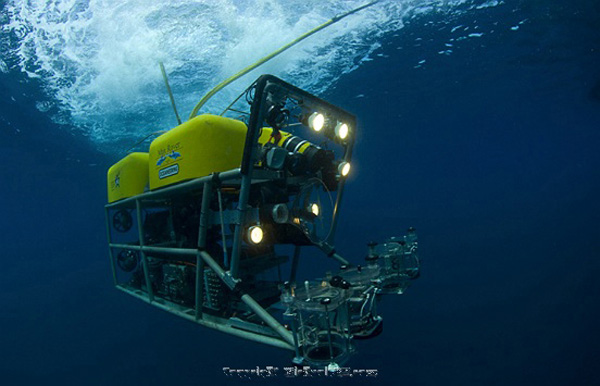
Once the design process is finished, the final product will be an ROV able to compete in the MATES ROV competition that will be proficient at completing the competition tasks. This includes taking water samples, taking temperature readings, navigating a cave, listening to underwater sound sources, and taking an agar sample. The objectives that will drive the success of these tasks include accurate buoyancy, precise construction, and fluidity of controls.
 |
| Figure 1: ROV in action |
Upcoming Presentation
As part of the course requirements, the students designing a senior project as part of Systems Engineering II must brief the class and instructors on the progress of their projects once per quarter. For the second marking period, this includes an update on the construction and production of the final solution. The presentation will be formally conducted in a professional manner. This assignment simulates the progress update that every engineer under contract owes the client. The class and instructors will simulate the client, while the student will simulate the engineer.
Recap
Students from MAST have been designing and building a senior project as part of the Systems Engineering II curriculum. The students designing an ROV will be testing their final solutions in competition format on April 5, 2011. The event should be a true measure of the skill and ingenuity of the students. The public is invited to spectate, and the competition is bound to be an exhibition of the students’ technological prowess.
For more details about the ROV competition in
Long Branch, New Jersey, contact Ross Basri at rbasri@mast.mcvsd.org or visit MAST at www.mast.mcvsd.org
About the Marine Academy of Science and Technology The Marine Academy of Science and Technology (MAST) is a co-ed four-year high school, grades 9-12; one of five career academies administered by the Monmouth County Vocational School District. The Marine Academy is fully accredited by the Middle States Association of Schools and Colleges and offers small classes with close personal attention. The Marine Academy was founded in 1981 as a part-time program, which has since grown to become a full-time diploma-granting program. The school's curriculum focuses on marine sciences and marine technology/engineering. The MAST program requires each student to participate in the Naval Junior Reserve Officer Training Corps (NJROTC) in lieu of Physical Education. MAST is located in the Fort Hancock Historic Area at the tip of Sandy Hook, New Jersey. The school campus is located adjacent to the Sandy Hook Lighthouse, the oldest working lighthouse in the country, in thirteen newly renovated buildings, within walking distance of several beaches. The "Blue Sea" is a 65-foot research vessel owned and operated by the Marine Academy and berthed at the U.S. Coast Guard Station, Sandy Hook. The vessel is used in all facets of the program.