Monday, November 1, 2010

Plan of Procedures


Processing:
P1
-Use band saw to cut PVC into pieces 24" long

P2
-Use band saw to cut PVC into pieces 18" long

P4
-Use snips to cut perforated aluminum into 2' x 2' square
-Use snips to cut 2" x 2" squares off corners of the sheet

Procedure:
  1. Lay out all materials and supplies on a work bench and check for any safety hazards.
  2. Attach the eight pieces of 2 feet PVC to the side-outlet 90's to form two bases.
  3. Place the aluminum deck on the top of one base so that the corners
  4. Attach the 18" PVC pieces to the side-outlet 90's as the vertical columns.
  5. Use expoxy to seal the side-outlet 90's and keep them water-proof.

Orthographic

Exploded

Isometric

Model

Wednesday, October 13, 2010

Wednesday, October 6, 2010

Research

The objective of the design process is to aid in designing and building an ROV collaboratively. The function of the ROV is to perform a series of tasks in an unpredictable, underwater environment. The goal is to compete in, and ultimately win, the MATE's ROV competition.

Problem
The Marine Advanced Technology Education Center holds many different ROV competitions annually. The different competitions involve students from middle schools, high schools, home schools, community colleges, and universities. Different competition classes exist for varying levels of sophistication of the ROV's. My ROV will be entered in the Ranger class. As part of the competition, the ROV will be tasked with the completion of a series of underwater tasks. In the past, these have included grasping objects with a robotic arm, taking the temperature of different areas of water, listening to the site of sound production, and navigating a cave.

Figure 1: Example of a giant ROV used for naval operations
Figure 2: Example of an ROV used in Oil Operations

Environment/Conditions of Use
Each of MATE's ROV competitions are held in a pool. The pool shown on the official pool tour is outdoors and 6 feet deep, but the pool may be indoors or outdoors. Whether the pool is outdoors or indoors this year should not affect the competition. There may be slight discrepencies between sunlight and indoor light, but these are negligible. Presumably, the competition will not be held in bad weather outside. Since the competitions will be conducted in a pool, currents should not be taken into account. Still, the underwater environment can be unpredictable, as any small drift may affect the position of one of the competition materials. The competition involves a task in which the ROV must explore an 80 cm by 80 cm cave, which is pictured below. This could be a potential snag area for the hull. The hull must accommodate the cave by being small and maneuverable enough to negotiate the cave without difficulty.

Figure 3: Potential Outdoor Pool

Figure 4: Potential Indoor Pool

Figure 5: 80cm x 80 cm Cave


End User
The finished ROV will be used in competition. It will be controlled by one of the three members of my group. My group consists of myself, Matt Gannon, and Matt Johnson. The electrical expert is Matt Gannon. He will be designing the control system of the ROV, and he will most likely be the most familiar with it. For this reason, Matt G. is probably the best choice for the person who will control the ROV. He is right-handed and has large hands. Matt will be manning the ROV from the poolside control shack, pictured below. Matt Johnson and I will be doing auxiliary work, including management of the cables.

Figure 6: Poolside Shack


Figure 7: Engineering Group/End User

Friday, October 1, 2010

Rationale

The idea matrix shows that Solution 1 is the best suited for the job based on the specifications. Using these guidelines, it should be the best solution for the parameters of the competition, including environment and use.

One con of solution 1 is its size and shape. A box is not very hydrodynamic, and it is the largest solution. As a result, it lost points in the idea matrix in the area of propulsion, as drag provides more resistance. It also lost points in the easy to operate category, as it is clunky and somewhat burdensome to use. Its bright spots were its neutral buoyancy and its ability to accommodate the robotic appendage.

Solution 2 also had some trouble because of its shape. While it was designed to make smooth landings on the floor of the pool, it did provide for excellent maneuverability. The fact that it is heavier than neutrally buoyant may play to its advantage in landing, but it makes the ROV harder to control. While this solution did not receive the worst grade on any one specification, it never received the best grade.

The main disadvantage of solution 3 is its size. While its power to size ratio is excellent, it is small and may provide trouble when trying to fit it with a robotic appendage. Additionally, it may have trouble handling all the competition materials that must be picked up along the way. The positive to this solution is its relative power and maneuverability. It would be easily operated by the control expert, although the fact that it is lighter than neutrally buoyant may not facilitate smooth movement through the water column.

Solution 1 is the solution that will be implemented. It is best suited for completing the competition tasks. The factors that were considered in the idea matrix were the specifications, and they included propulsion, buoyancy, maneuverability, size, and accommodation of the robotic appendage.

Calendar

Tuesday, September 28, 2010

Works Cited

"ROV Applications- Academic/Scientific." Remotely Operated Vehicle Committee. Marine Technology Society. Web. 03 Sept. 2010. .

“ROV Applications- Commercial Offshore." Remotely Operated Vehicle Committee. Marine Technology Society. Web. 03 Sept. 2010. .

"ROV Applications- Military." Remotely Operated Vehicle Committee. Marine Technology Society. Web. 03 Sept. 2010. .

Log

9/28: This week, I am focusing on choosing a solution. My alternate solutions are up and running, but the developmental process must go on. I am working on refining my idea matrix, in which I compare the alternate solutions with respect to the specifications. Once I have figured out which solution measures up best against my specs, I have to put together a seleciton/rejection report. My design brief and specs and limits are still being refined as criticisms come in from my mentor. I will work on keeping up mentor contacts as I need to fulfill the requirement before the end of the marking period.

10/1: It is the end of the week. One of the things I have posted this week was my calendar. Besides that, I have made a mentor contact, and I have touched up my solutions. The next step for me is to get my rationale posted. I have done the developmental work, including an idea matrix, but I just have to put that into words and make a final selection.

10/6: Today, I posted my research, which was done over the summer but needed much refining. The next imminent assignment is the model, which will be due near the end of the month. For the rest of the week, I will focus on preparing a method for building the model. I will do some working drawings and determine exactly how it will look.

Friday, September 24, 2010

Solution 1

The thought that went into my solutions was multi-faceted. As the hull architect, I had to take into account the placement of the subsystems, while keeping in mind both the power to size ratio and buoyancy. My goal in the following was to provide solutions that could be compared against my specs. This way, a clear "best solution" could be determined. As such, I tried to vary materials, subsystem locations, and buoyancy from solution to solution.


Solution 1 is close to cubical in dimensions, but the width is slightly longer than the length. There are four propellers, two located on the top and two in the back. The robotic arm is located on the opposite side of the propellers. This ROV is neutrally buoyant, so the up/down propellers will do all work to move the ROV through the water column. The power cable release is located on the top of the ROV in the space between the up/down propellers, and is encased within a plastic tubing to keep it from becoming tangled with the up/down propellers. Its dimensions were 2’ x 2’6” x 2’6”, but has since been reduced to 1'6" x 2' x 2' to accomodate buoyancy. Its frame is made of PVC pipe 1.5" in diameter.

The total displacement of this hull, considering the new dimensions and that all pvc is capped, is 466.3 cubic inches. This converts to 7,641.3 cubic centimeters. Since the density of water is 1, this hull will displace 7.64 kg of water. 

Soltuion 2


Solution 2 is trapezoidal. The area of the base is greater than the area of the top, but the only dimension that changes is width. The trapezoidal shape makes the side an A-frame, making the ROV sturdy and ideal for landing on the ocean/pool floor. The hull is slightly heavier than neutrally buoyant, so the hull will want to sink. Fortunately, the A-frame provides support in a landing scenario. The cable release is located on aside of the ROV on its own face adjacent to the mechanical arm and forward/back propellers. This way, it is far from any of the subsystems and should not get caught or tangled. The dimensions of the top face are 2’ x 1’6”. The dimensions of the base are 3’ x 1’6”. It is 1’6” high. It is made out of a mixture of PVC and aluminum.

Considering the trapezoidal section containing the electrical components, including the motors, is dry, the displacement is high. The total displacement of the hull should be around 2,916 cubic inches, or 47,784.68 cubic centimeters. Since the density of water is 1, the hull will displace 47.78 kg of water.

Solution 3


Solution 3 is differentiated from the rest in a few ways. For one, it is the smallest of the three, by far, which facilitates it having the highest power input/size ratio. The ROV is slightly lighter than neutrally buoyant, so it will naturally want to float to the surface. However, this design has the same amount of power input to the up/down propeller as the other designs with less weight to have to push back down the water column. Its dimensions are 1' x 1' x 1'6". It is made of aluminum and PVC.

The displacement of this hull is 180 cubic centimeters, as some members are made of capped pvc. This number equates to 2,950 cubic centimeters, or 2.95 kg of water.

Now that the solutions have been determined, they each need to be compared against the specifications. The "best solution" will surface, and then I can run with the solution most suited for the task.

Thursday, September 23, 2010

Brainstorming

           The design challenges can be sorted according to subsystems. Each subsystem has its own nuances to keep in mind for optimal function. The main subsystems of the ROV are buoyancy/architecture, robotic arm, and propulsion.

Buoyancy/Architecture
            In terms of buoyancy, the goal for the ROV is to be very close to neutrally buoyant. Sometimes, ROV’s are slightly heavier or lighter than neutrally buoyant according to user preferences. When the ROV is close to neutrally buoyant, the propulsion system is more effective. Buoyancy also determines how much real payload an ROV can carry (“Buoyancy”).
            The goal of the architecture is to make sure that each subsystem can operate seamlessly and independently. Absolutely essential to the design of the architecture is cable management. If the cables interfere with or get caught in any other subsystem, the ROV will be very difficult to operate. Strategic placement of cables needs to be planned.
            I hypothesize that it would be best to build the ROV slightly heavier than neutrally buoyant. This, way, there will always be a downward force acting on the ROV, and a propulsion system to move down the water column will be unnecessary. On the other hand, this design requires constant upward propulsion to avoid moving down the water column constantly.

Robotic Arm
            The key the robotic arm is to use the simplest design possible that can get the job done. Because of the largely uncertain nature of the marine environment, complexity can often result in problems with reliability, operation, and maintenance (ROV Applications- Design- Manipulators”). It is important that the orientation of the arm can be manipulated as to get the best leverage and angle of approach on the object that is trying to be lifted. Generally, robotic appendages have two sets of prongs opposite each other to fully encompass the object that is being gripped. It is important that the grip is tight on the object so that it is not dropped while being transported.

Propulsion
            The propulsion system will largely depend on the size of the ROV. The bigger the ROV, the more power required to make it move. There is a tradeoff with feedback effects between propulsion and the other subsystems, because the larger the other subsystems are, the more power required, which means a larger propulsion system, which means even more power required. The ultimate goal of a propulsion system is a high “thrust to physical size and power input ratio.” Also, conditions of use for a propulsion system built for a specific client need to be taken into account because a more powerful propulsion system is needed to operate in stronger sea currents (“ROV Applications- Design- Propulsion”).
            As our competition will take place in a controlled pool environment, a heavy-duty propulsion system is unnecessary. However, it is still important to take into account the thrust to physical size and power input ratio because this will determine how powerful the propulsion system will be given the size of the ROV. Reversible propellers will be an important material to have because they allow the solution to only need propellers on one side to move in both directions. 

Wednesday, September 22, 2010

Testing Procedures

The prototype of the solution that will be tested should be able to move in the x and z planes of the water, as well as submerge and resurface. It must be able to submerge 6 feet in depth and withstand 18 psi. Certain tasks the hull must be fit to perform include descending to the bottom of the pool to take the temperature and listen underwater at designated checkpoints, as well as negotiate an underwater cave. For this reason, hull buoyancy must be precise to deliver responsive maneuverability.

For hull design-
  • As a preliminary exploratory and comparison test, gather all hull materials, including pvc and aluminum. Set up a testing basin at least 3 feet deep. Place all prospective materials in the basin and observe buoyancy properties. Assess which materials would work as buoyancy and which would work as ballast.
  • As a secondary exploratory and comparison test, put the prospective materials in a covered basin halfway filled with water. Shake the basin vigorously for about a minute. Let the materials settle and open the basin. Assess which materials are the most durable.
  • As a tertiary exploratory and comparison test, put the prospective hull materials in an open container, such as a cage, and submerge the cage at a depth of 7 feet in a testing pool. Let the materials sit for about 12 hours. After 12 hours, resurface the container and observe the materials. Look for corrosion and cracks. Assess which materials will be the most resistant to corrosion and water pressure.
  • Once the materials are chosen, present a preliminary model of the hull in a dry environment to explore the group’s feelings toward the proposed form and function. Reiterate if necessary to match the competition requirements regarding functionality and user interface.
  • Begin construction on a prototype in a dry environment. Measure and cut all chosen materials precisely. Employ the help of team members if needed.
  • Take hull to a testing pool about 6 feet deep and perform a preliminary assessment test. Submerge the hull and test for neutral buoyancy. Adjust ballast as necessary. Submerge to a depth of at least 6 feet and observe resistance to water pressure. Assess the viability of the hull under pressure.
  • Once hull is determined to be viable, attach the subsystems. Prepare a secondary assessment and comparison test to evaluate the propulsion, buoyancy, and robotic arm subsystems in a wet environment. All the components of the ROV that would be used in competition are needed.
  1. Fill a pool with water at least 10 feet deep and a plastic ball.
  2. Test the propulsion system by having the ROV take 3 laps around the pool.
  3.  Test the buoyancy and propulsion systems by having the ROV touch the bottom of the pool and resurface 3 times. Note whether the ROV feels too light or too heavy. This can be a subjective judgement made by the operator.
  4. Test the robotic arm by grabbing the ball and bringing it to the surface 3 times.
  5. Observe problems and draw conclusions about the viability of the design. Compare results to other possible solutions.
·        Prepare a tertiary assessment test to evaluate completion of competition task in a wet environment.
1.      Meet with instructors to consult on nature of task and how laboratory conditions can be prepared to mimic task.
2.      Prepare laboratory conditions to competition specifications and set up a simulation of the client’s task.
3.      Have the ROV attempt to complete the tasks 3 times.
4.      Observe problems and make notes on ways to improve performance.
·        Once the task is able to be completed to satisfaction with consistency, invite the instructor to the lab to perform a preliminary validation test with the same objective and in the same environment as described above. Tests should be performed by the control expert/operator.
·        Receive feedback from instructor and reiterate design if necessary.

 
Things to Observe-
·        During in-laboratory testing, observe mobility and maneuverability in the water column. Product should be close enough to neutrally buoyant that it is unhindered by excess or lack of buoyancy in any direction.
·        Observe buoyancy of cables and location of connections. Ensure that cables do not interfere with any other subsystem or keep product from completing client-specified task.
·        Observe placement of subsystems. Ensure that propulsion is located in a spot that promotes maneuverability. Ensure that robotic arm is located in a spot that promotes completion of each objective pertinent to the client-specified task.


Testing Environment

 
Competition Environment

 
Survey
Thank you for cooperating and participating with our testing procedures. When followed with care and precision, these procedures will ensure a product best fit to your needs and specifications. However, to guarantee premium quality, it would be very helpful to have you take a couple of minutes to answer these questions thoughtfully.

 
On a scale of 1-5, with 5 meaning near perfect and 1 meaning very poor, how would you rate the following aspects of the solution and testing?

 
1. How well were actual conditions replicated during testing?

 
1          2          3          4          5

 
2. How well was your task simulated during testing?

 
1          2          3          4          5

 
3. How easy to use were the controls to the ROV?

 
1          2          3          4          5

 
4. How well did the propulsion system perform?

 
1          2          3          4          5

 
5. How well did the architecture (including buoyancy) function?

 
1          2          3          4          5

 
6. How well did the robotic arm function in terms of manipulability?

 
1          2          3          4          5

 
7. How well was the robotic arm suited to perform your specific task?

 
1          2          3          4          5

 
8. How well did the ROV perform in deep water?

 
1          2          3          4          5

 
9. Does the ROV conform to your size limitations?                    YES                 NO

 
10.  Does the ROV conform to your power limitations?              YES                 NO

 
11. Was the ROV burdensome or strenuous to use?                 YES                 NO

Specifications and Limitations

Specifications:
  • Must be able to complete competition tasks
  • Must function in a fresh, chlorinated, electrically conductive, underwater environment
  • Must be optimally buoyant for unhindered movement through the water column
  • Must be able to accept a robotic appendage that can be manipulated from above the surface
  • Must have a propulsion system adequate for subsurface mobility
  • Must be operable by group's right handed control expert
  • Must be larger than 3 cubic feet to handle competition materials
Limitations:
  • Cannot exceed 12 cubic feet
  • Cannot use corrosive materials
  • Cannot use materials permeable by water
  • Cannot use materials that will collapse under water pressure

Design Brief

Team Design Brief:
Design and build a Remotely Operated Vehicle collaboratively to perform a series of tasks that my team and I can use in an unpredictable, underwater environment while competing in the MATE's ROV competition.

Individual Design Brief:
Design and build the hull of the ROV for my team's use to include the strategic placement of subsystems and optimal buoyancy while using suitable materials for seamless mobility in the underwater/pool environment of the MATE's competition.

Tuesday, September 21, 2010

Background Information


Problem/Situation

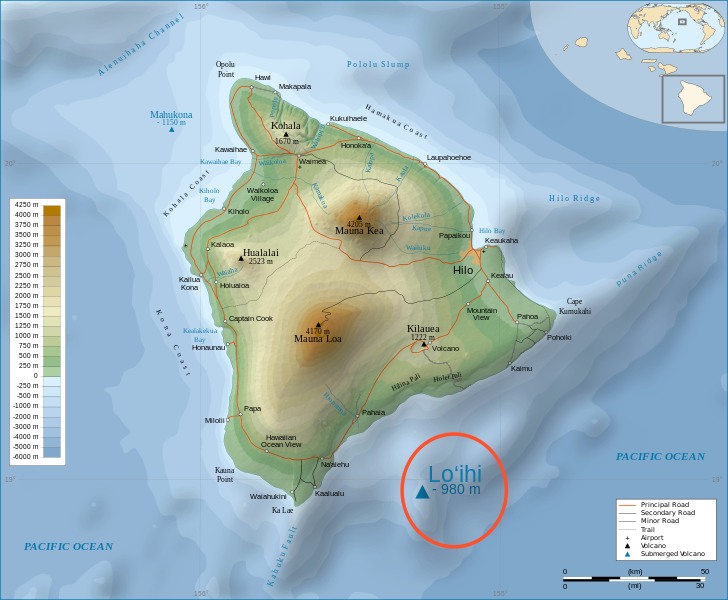
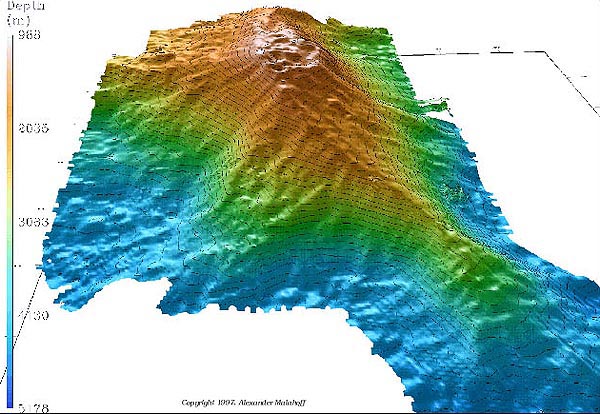
The open ocean is an inhospitable and generally difficult to penetrate environment. For example, HUGO, the research station set up to monitor seismic activity of the seamount Loihi, has lost functionality. Its cable became flooded, cutting off power to the system and barring scientists from continuing to gather data on Loihi. Somehow, HUGO must be revived, or else the data must come from another means, but unfortunately, the deep-sea environment is too dangerous for a dive team. To simulate this problem, and provide students the opportunity to come up with a solution, the MATE's ROV competition requires certain tasks to be accomplished remotely in an underwater environment.

HUGO

Map showing location of Loihi off Hawaii

Model showing the contours of Loihi


People Involved

As a group, my team will represent the engineers in the industry designing solutions to the problem. Each of us has been assigned a different focus, just as each member of an engineering team would work on a different component of the solution. Besides science, these engineering teams cater to commercial and government entities with an interest in unfeasible undersea operations. Commercially, for example, oil extraction companies are interested in exploiting the untapped reserves of hydrocarbons that lie beneath the ocean floor ("ROV Applications- Commercial"). Academically, scientists and researchers in the field of marine biology have taken a profound interest to deep-sea ecosystems, especially those located around hydrothermal vents; however, most of these ecosystems lie beneath the threshold of safe diving and are unreachable by the scientists ("ROV Applications- Academic/Scientific"). The military also has encountered similar problems. Mine countermeasures, underwater reconnaissance, and recovery of lost devices and weapons are all tasks that are beyond the capabilities of dive teams ("ROV Applications- Military”). While we do not have client-centered specifications, the competition specs should simulate the design process from the perspective of a professional engineer.


Significance

Competing in the MATE's ROV competition affords students the opportunity to learn and practice ROV design while gaining exposure to the methods of engineering. ROV design is a very relevant learning experience today. The versatility of an ROV makes it an attractive solution to commercial, academic, and government issues alike. All of these entities have vast reserves of capital to spend on solutions to their problems. In short, a solution to the similar problems faced by these entities, when well engineered and marketed, would be extremely lucrative. There are reasons aside from financial gains to help these entities, too. Helping oil companies search for oil would help curb the US dependence on foreign oil, as well as keep a steady supply at market, and, as a result, gas prices low for the American consumer. Aiding scientific research will lead to new breakthroughs. Providing a solution to the military is not only patriotic but a contribution to national security. 


Mood of Design

The mood that needs to be conveyed by the design is one of versatility, reliability, and durability. Each customer has a different problem and objective. Because of this, a versatile solution allows for a broader range of tasks that can be completed with a single product. Reliability is crucial because if the solution fails or breaks down during a mission, it will reflect badly on the producer and result in a damaged reputation, making future sales more difficult. Lastly, durability is important because quality, personalized solutions are generally expensive, and although the potential clients are wealthy, a product with a reputation of durability will assure them that they are making a safe investment. In terms of the competition, customer appeal is of less importance, but to engineer a quality solution, these characteristics must be taken into account.


Versatile


Reliable

Reliable
Maytag- Durable
Durable

Products With Similar

Functions

There are certain products with functions that may prove usable in a solution to the problems outlined above. Obviously, the solution needs to be remotely operated, a technology observable in remote controlled cars. During the competition, the ROV will have to take a temperature reading remotely, so a thermometer will have to be used. A robotic arm, such as those used by NASA, allows for an operator to make decisions based upon pressures from unforeseen and external forces and allows for a multitude of various tasks to be completed. Mobility is important, and the balance between propulsion and buoyancy that would need to be used for the solution could have its roots in submarines, as they are able to move freely up and down the water column. Lastly, a hydrophone will be needed to perform the task in which the ROV must identify the source of a noise.